

Nov
Injury Rehabilitation and Training
Proprioceptors: Your Spatial Awareness Nerve Receptors
What Is Proprioception?
Proprioception is the innate sense of knowing, without having to see ourselves, our body’s relative position in space. Proprioception allows us to navigate life inherently knowing where our limbs and center of gravity are at any time. Your proprioceptors are specialised sensory receptors that relay information about our body’s spatial position to the brain. The brain then analyzes the information provided, giving us an awareness of where our body is in space. Proprioceptors are the receptors situated on nerve endings and are present in muscles, skin, joints, tendons…
Where Are Your Proprioceptors?
There are many proprioceptors in the human body. The receptors connected within the musculoskeletal system are the pacinian corpuscle, the muscle spindle, and golgi tendon organs.
- Pacinian corpuscles are pressure sensors in the skin responsible for detecting changes in movement and force within the body.
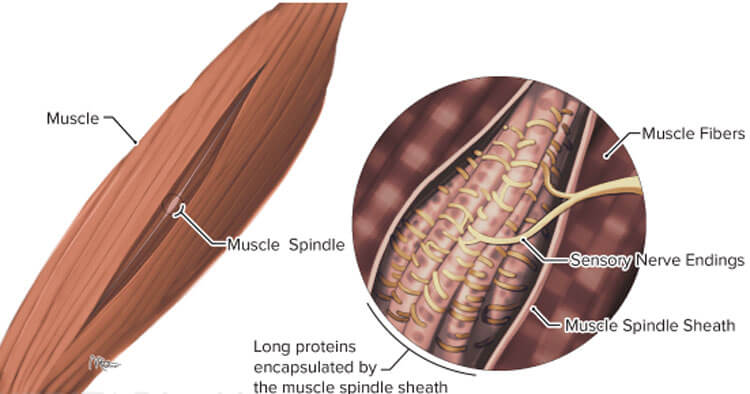
- Muscle spindle receptors are stretch receptors that tell the brain how fast and how much a muscle is under stretch, or how quickly it is moving. Input from these receptors alert the brain to changes in muscle angles and position.
- Golgi tendon organs are receptors found where the muscle and tendon join. These are stretch inhibitor receptors and work by informing the brain to slow down because the tissue doesn’t have the ability to stretch.
As mentioned there are proprioceptors situated in joints, ligaments, muscle, skin.. all sending information to the nervous system. The proprioception sensory system utilizes the input and signals our brain receives from all receptors. These signals are processed and then an overall sense of the position and motion of your body is constructed. Utilizing this information commands are sent back to the muscle to adjust movement and position accordingly.
Disclaimer: Sydney Physio Clinic provides this information as an educational service and is not intended to serve as medical advice. Anyone seeking specific advice or assistance on Proprioceptors: Your Spatial Awareness Nerve Receptors should consult his or her physiotherapist, general practitioner or appropriately skilled practitioner.
